

Table of Contents
- Does the NHS Cover Continuous Glucose Monitors? The Short Answer
- NHS Continuous Glucose Monitor Eligibility: Who Qualifies
- How to Get a CGM on the NHS: A Step-by-Step Process
- CGM vs Flash Glucose Monitoring: Key Differences
- What If You Don't Qualify for NHS CGM Coverage?
- Frequently Asked Questions
Last Updated: 21 October 2026
Does the NHS Cover Continuous Glucose Monitors? The Short Answer
Yes, the NHS does cover continuous glucose monitors, but not for everyone. NHS CGM coverage is restricted to people who meet specific clinical criteria set out in national guidance, and access varies by diabetes type, treatment regime and local commissioning arrangements. At Air Liquide Healthcare, we speak to people every week who assume funding is automatic and discover it is not.

Sibionics GS3-R Continuous Glucose Monitor (CGM)
The practical answer sits in three parts. People with type 1 diabetes generally have the clearest route to funded CGM. Some people with type 2 diabetes qualify, mainly those who manage their condition with insulin. Everyone else usually pays privately or relies on intermittent flash monitoring.
Below, we explain exactly who qualifies, how the referral process works, and what to do if you fall outside the criteria.
NHS Continuous Glucose Monitor Eligibility: Who Qualifies
NHS continuous glucose monitor eligibility depends on your diabetes type, your treatment and whether your clinician agrees the technology will help you hit agreed glucose targets. Funding is not universal, and a GP cannot simply prescribe a sensor on request.
The National Institute for Health and Care Excellence guidance on glucose monitoring sets the framework clinicians follow. Your diabetes team applies it alongside local commissioning rules.
Type 1 Diabetes and CGM Funding
Adults with type 1 diabetes have the strongest claim to funded CGM. NICE recommends real-time continuous glucose monitoring for all adults with type 1 diabetes, subject to a conversation with your diabetes team about whether it suits your circumstances. Children and young people with type 1 diabetes are also covered.
In practice, that means most people with type 1 who want a sensor can get one through their hospital diabetes clinic. The clinic supplies the hardware and sensors, and you change them at the intervals the manufacturer specifies.
Type 2 Diabetes and CGM Funding
Type 2 diabetes is where funding tightens. NICE recommends CGM for adults with type 2 diabetes who manage their condition with insulin, particularly where finger-prick testing is burdensome or where hypoglycaemia is a concern. If you manage with tablets, diet or other injectable medication, funded CGM is unlikely.
That is not a verdict on whether CGM would help you. It reflects how the NHS rations a finite budget. Many people with type 2 diabetes buy sensors privately for exactly this reason.
How to Get a CGM on the NHS: A Step-by-Step Process
Getting a CGM on the NHS starts with a conversation with your diabetes team, not a purchase. The process is straightforward once you know who to ask, but it moves at the pace of the clinic rather than the pace you would like.
- Check your eligibility. Confirm your diabetes type and treatment regime against the NICE criteria before you raise it.
- Book a diabetes review. Ask your GP or hospital clinic for a routine review and flag that you want to discuss CGM.
- Prepare your case. Bring your glucose readings, a log of hypoglycaemic episodes and any concerns about finger-prick testing.
- Get a specialist referral. Your GP can refer you to a hospital diabetes team if you are not already under one.
- Attend the education session. Most clinics require you to complete training on sensor use and interpreting the data.
- Receive your first sensors. The clinic arranges supply, usually through a home delivery service.
- Review after a few months. Your team checks whether the sensor is improving your glucose control.
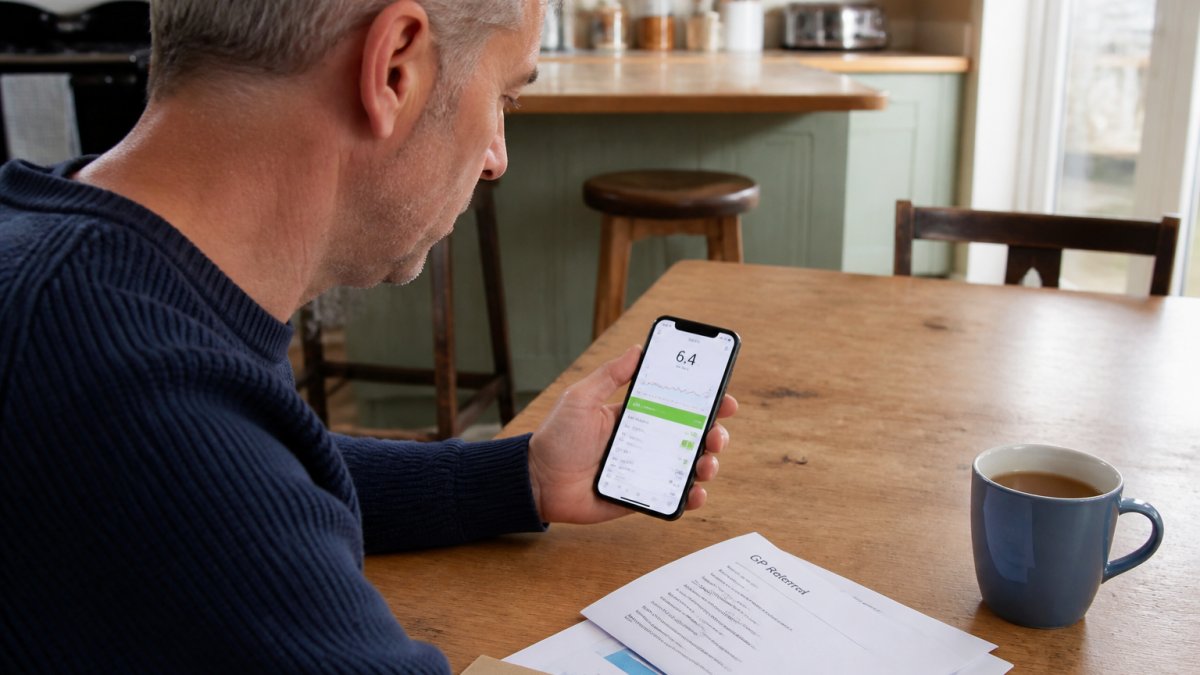
A person with diabetes sitting at a kitchen table, looking at a smartphone app showing glucose readings, with a GP referral letter and a cup of tea nearby
The whole process typically takes weeks rather than days. Waiting lists for diabetes specialist appointments vary considerably by area.
CGM vs Flash Glucose Monitoring: Key Differences
CGM and flash glucose monitoring both measure glucose in interstitial fluid, but they serve different needs. The distinction matters when you are making your case for funding.
Sibionics GS3-R Continuous Glucose Monitor (CGM) →
Feature |
CGM |
Flash glucose monitoring |
|---|---|---|
Reading method |
Automatic, continuous transmission |
Manual scan with phone or reader |
Alerts for highs and lows |
Yes, customisable |
Limited or none |
Data sharing in real time |
Yes, via app |
On scan |
Typical funded user |
Type 1, and type 2 |
Type 1, some type 2 on insulin |
Best for |
People needing alerts and remote monitoring |
People who prefer on-demand readings |
CGM suits people who need to know about a falling glucose level before they feel it. Flash monitoring suits people who want a convenient alternative to finger-prick testing without constant alerts.
If you are weighing private options, our Sibionics GS3-R Continuous Glucose Monitor at £48.00 delivers real-time readings with customisable high and low alerts, up to 14 days of wear per sensor, and IP38 water resistance for showers and short swims. It is intended for people aged 3 and older with type 1 or type 2 diabetes.
What If You Don't Qualify for NHS CGM Coverage?
Not qualifying does not mean going without. Plenty of people monitor continuously by buying sensors privately, and the cost is more manageable than many expect.
Private CGM is a straightforward option. You buy sensors directly, pair them with the manufacturer's app, and share reports with your clinician at appointments. Our Sibionics GS3-R three-sensor pack costs £120.00, and a two-sensor pack costs £85.00.

The GS3-R has a MARD value of 8.7%, which describes how closely its readings track a laboratory reference. Pair it with a finger-prick test whenever a reading does not match how you feel.
A common mistake is buying a sensor without a plan for what you will do with the data. Decide in advance which patterns you want to spot and who will review them.
Frequently Asked Questions
Does the NHS provide continuous glucose monitors?
Yes, the NHS does provide continuous glucose monitors, but access depends on your clinical needs and local funding. NHS CGM coverage is not universal. Eligibility is guided by NICE recommendations and local integrated care board policies. People with type 1 diabetes who meet specific criteria, such as having recurrent hypoglycaemia or needing real-time alerts, are most likely to qualify. Some people with type 2 diabetes on insulin may also be eligible. Your diabetes team assesses whether a CGM is clinically appropriate for you and whether NHS funding is available in your area.
Who is eligible for a continuous glucose monitor on the NHS?
NHS continuous glucose monitor eligibility typically includes people with type 1 diabetes who have problematic hypoglycaemia, need help with insulin adjustment, or require real-time alerts for safety. Pregnant women with type 1 diabetes may also qualify. Adults with type 2 diabetes who use insulin and have recurrent low blood sugar may be considered. Children and young people with type 1 diabetes are often prioritised. Your diabetes consultant or specialist nurse makes the final decision based on NICE guidance and local funding criteria, so ask your team directly about your situation.
Can adults with type 2 diabetes get a CGM on the NHS?
Some adults with type 2 diabetes can get a CGM on the NHS, but the criteria are narrower than for type 1. You are more likely to qualify if you use insulin and experience frequent or severe hypoglycaemia, or if you need real-time glucose data to adjust insulin safely. If you manage type 2 diabetes with tablets or diet alone, NHS funding is unlikely unless there are exceptional clinical reasons. Speak to your GP or diabetes team about whether you meet local criteria, and ask what evidence they need to support a referral.
Does the NHS prescribe FreeStyle Libre or Dexcom?
The NHS can prescribe flash glucose monitoring systems such as FreeStyle Libre and some CGM brands, but availability varies by region and clinical criteria. FreeStyle Libre is a flash glucose monitor, not a true CGM, because it requires scanning rather than sending automatic alerts. CGM systems that provide real-time alerts may be prescribed for people with type 1 diabetes who meet NICE criteria. Your diabetes team decides which device is clinically suitable and available on the local formulary. Ask your consultant or nurse which options your service funds.
Can I get a CGM on the NHS if I do not use insulin?
It is unlikely that you will get a CGM on the NHS if you do not use insulin, unless there are exceptional clinical circumstances. NHS funding is generally prioritised for people who need insulin and are at risk of hypoglycaemia, because CGM helps prevent dangerous low blood sugar. If you manage diabetes with tablets, diet, or lifestyle changes, your risk of severe hypoglycaemia is lower and CGM is less likely to be funded. You can still buy a CGM privately if you want real-time data to support your self-management.
What is the difference between a CGM and a flash glucose monitor?
A CGM continuously and automatically sends glucose readings to your phone or receiver, with real-time alerts for high or low levels. A flash glucose monitor, such as FreeStyle Libre, also measures glucose continuously but only displays readings when you scan the sensor. Flash monitoring does not provide automatic alerts unless you scan. CGM is often preferred for people who need warning of hypoglycaemia, especially at night. Both devices use a sensor worn on the skin, but CGM offers more automated data and alerting.
Can I buy a continuous glucose monitor privately if I do not qualify for NHS funding?
Yes, you can buy a CGM privately if you do not meet NHS criteria. Private CGM costs vary by brand and sensor lifespan. For example, the Sibionics GS3-R Continuous Glucose Monitor is available for £48.00 per sensor, with a three-sensor pack at £120.00 and a two-sensor pack at £85.00. Each sensor lasts up to 14 days. Private purchase gives you access to real-time glucose data without NHS approval, but you pay the full cost yourself. Always follow the instructions for use and speak to your healthcare professional about interpreting the data.
If you are navigating NHS CGM coverage and coming up short, you still have options. Air Liquide Healthcare supplies the Sibionics GS3-R, a real-time CGM with Bluetooth transmission, customisable alerts and up to 14 days of wear per sensor, backed by guidance to help you get the most from your readings. Get started with Air Liquide Healthcare and take control of your daily glucose management with confidence.